

Article Summary
Closing statements are persuasive final arguments used in trials, debates, and sales to distill your case and sway decisions. This article covers real-world examples, 12 craft strategies, and delivery tips. You'll gain a clear framework for writing closing statements that resonate and persuade.
Closing statements are pivotal in trials, debates, and speeches to sway opinions in one’s favor. This article explores crafting strong closing statements with examples and practical tips for adaptation across contexts.
Introduction to closing statements
Whether you’re witnessing a courtroom drama or engaging in a heated debate, closing statements are your grand finale. They hold the power to encapsulate your arguments and sway the final decision.
Importance of closing statements
These statements aren’t just formalities; they’re crucial. They distill your whole argument into a final, persuasive pitch. What’s at stake? Often, everything.
Real-world examples of closing statements
- During the 2023 defamation trial between Johnny Depp and Amber Heard, Depp’s lawyer emphasized, “It’s about restoring his name,” framing the trial as a quest for truth rather than a legal battle. This closing statement aimed to steer the jury towards a verdict redeeming Depp’s reputation.
- In the 2022 trial of Elizabeth Holmes, former CEO of Theranos, the prosecution’s closing zeroed in on her intent to deceive, stating, “She chose fraud over business failure.” This statement highlighted Holmes’s repeated decisions, influencing jurors to consider her deliberate actions throughout the trial.
- Recall the 2021 Derek Chauvin trial. Prosecutor Jerry Blackwell’s phrase, “Believe your eyes,” focused the jury on the clear video evidence, similarly demonstrating how a succinct closing statement can anchor a case and influence the verdict
- Reflecting on the 1995 O.J. Simpson trial, Johnnie Cochran’s iconic phrase, “If it doesn’t fit, you must acquit,” remains memorable years later. That simple statement about the glove is a legendary example of how a powerful closing argument can shape history.
Real-world trials clearly show the stakes, but let’s not forget how TV and movies also bring the drama of compelling closing statements to life.
Fictional examples of closing statements
- In “A Few Good Men,” Lt. Kaffee, played by Tom Cruise, delivers a riveting closing when he presses Col. Jessup, saying, “I want the truth!” leading to the iconic response, “You can’t handle the truth!” This moment exemplifies the power of direct confrontation in closing arguments.
- Mick Haller, in “The Lincoln Lawyer,” masterfully secures his case with the statement, “A lawyer with a briefcase can steal more than a thousand men with guns.” This highlights the strategic cunning essential for achieving justice.
- During his closing argument in “A Time to Kill,” Jake Brigance invokes empathy with, “Now imagine she’s white,” after detailing the horrific crime, forcing jurors to confront their biases and demonstrating the emotional impact needed to sway a jury.
- In the movie “Legally Blonde,” Elle Woods, played by Reese Witherspoon, captures a critical moment in her closing statement by pointing out a key inconsistency regarding hair care rules, asking, “Isn’t it the first cardinal rule of perm maintenance that you’re forbidden to wet your hair within 24 hours?” This clever observation showcases her unconventional approach and emphasizes the role of detailed evidence in making a case.

How to craft a closing statement
Ready to close like a pro? Here’s how to nail it step by step. Kick-off with an attention-grabbing hook—think of it like a chart-topping hit that resonates instantly. Next, refresh everyone’s memory with the key points solidifying your stance.
Nail the introduction
Dive in with a bang! Use a jaw-dropping fact or an intriguing question to make your opening as memorable as a popular song. Your goal is to grab attention right from the start.
Highlight key evidence
Now’s your chance to bring your argument home. Clearly outline why your side is unbeatable with a clear and concise presentation of the most compelling evidence.
Tackle counterarguments
Don’t duck away from challenges. You’ll fortify your position by addressing and dismantling potential loopholes head-on, proving that strategy and anticipation win debates.
Conclude with impact
Wrap up your argument with both passion and clarity. Think of it as sealing the deal—your conclusion should echo in their minds, leaving no room for doubt about your winning stance.
Strategies for impactful closing statements
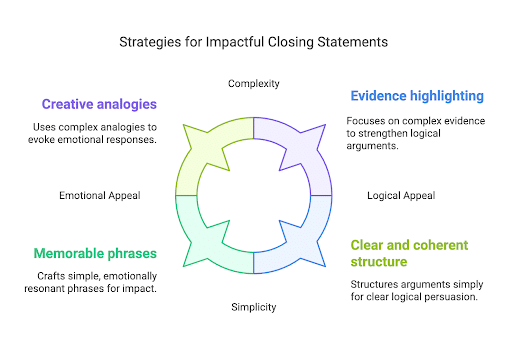
12 Keys to crafting an impactful closing statement
- Persuasive language: Use compelling language that captivates and persuades your audience.
- Clear and coherent structure: Start strong, present evidence clearly, address opposition, and conclude decisively.
- Direct confrontation: Challenge inconsistencies or highlight truths with straightforward questions.
- Creative analogies: Employ memorable sayings or comparisons to reinforce your argument.
- Emotional and logical appeal: Balance emotion with logic to craft a relatable and rational narrative.
- Evidence highlighting: Focus on key evidence, offering unique insights to leave a lasting impression.
- Core message emphasis: Center your argument around the primary theme, like truth or justice.
- Intent and motive: Clarify the intentions behind actions and their significance.
- Memorable phrases: Use striking phrases that encapsulate your message succinctly.
- Simplify complexity: Break down complex details into easily digestible ideas.
- Appeal to core values: Anchor your arguments in universal truths and values.
- Conviction in conclusion: End confidently, leaving no doubt about your position.
Significance of delivery in closing remarks
Words are powerful, but how you deliver them can amplify their impact. The right tone and confident body language can make or break your statement.
Tone and body language
Your stance should reflect confidence. A strong, clear voice mirrored by assertive body language reinforces your words.
Engaging the audience
Keep the audience hooked as if they’re watching the latest thriller. A powerful delivery keeps eyes wide and ears attentive.
Adapting closing statements across contexts
While essential in the legal realm, closing statements also find their place in debates and public speeches. Tailoring your approach for each context ensures maximum impact.
Legal trials
Involves intricate argument wrapping, heavily reliant on laws, evidence, and human emotion.
Professional debates
Here, your credibility is on the line. Logical reasoning and demonstrative evidence hold sway.
Speech conclusion
Speakers’ Closing remarks strive to leave a lasting impression, stirring thought and emotion.
Sales meetings
Your closing statement should captivate interest, spotlight key benefits, smoothly address any objections, introduce urgency, and finish on a high note to strengthen decision-making.
Conclusion
Your closing statement is your final bow, encapsulating all you’ve argued. Done correctly, it leaves a resonating impression, often turning the tide.
FAQs
What is a closing statement in a debate? It summarizes your position, reinforces arguments, and aims to persuade the judges or audience in competitive debates.
How long should a closing statement be? Length can vary but should be concise enough to maintain engagement yet detailed enough to cover essential points.
Are closing arguments and closing remarks the same? While similar and often overlapping, closing arguments focus on evidence while closing remarks add an emotional and comprehensive slant. They share the same end goal—persuasion.
Why is delivery important in closing statements? Delivery ensures your argument is compelling and remembered, influencing how the audience perceives your points.
How to strengthen a closing statement’s emotional appeal? Relate personal anecdotes, resist inflammatory language, and connect on shared values to evoke emotion effectively.
Featured courses