

Article Summary
The best leadership lessons come from leaders who've faced real pressure and learned from it. This article covers key takeaways from McLaren Racing CEO Zak Brown, including resilience, asking questions, emotional control, and decision-making. You'll gain practical leadership lessons you can apply right away.
Imagine a workplace where a split-second decision can be the difference between winning or losing or cost millions of dollars. Now imagine trying to lead over 1,200 people in that environment while the whole world watches. This is the daily reality for Zak Brown, the CEO of McLaren Racing.
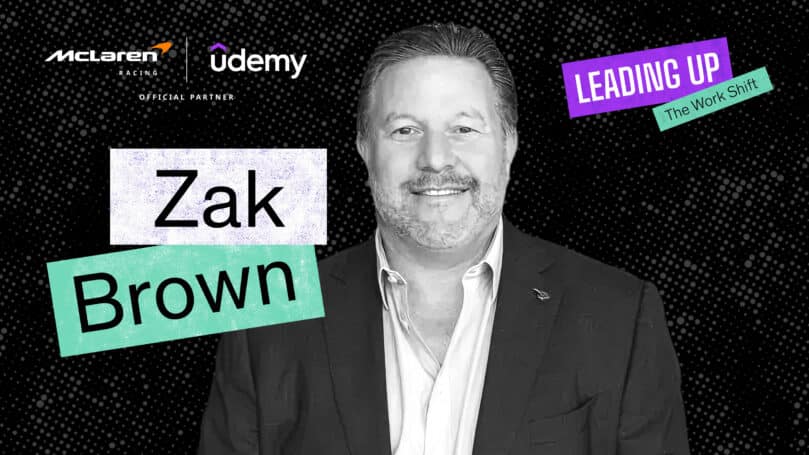
Whether you are navigating a corporate boardroom or a literal racetrack, the principles of high-performance leadership often look surprisingly similar. Recently, Elizabeth Weingarten–Director of Thought Leadership at Udemy–sat down with the racing executive for an episode of the Leading Up: The Work Shift podcast to discuss his journey from professional driver to marketing entrepreneur to F1 boss.
What stands out most about Zak Brown isn’t just his success, but his candor about his failures. He admits that his path wasn’t a straight line and that his “atypical career path is not without regrets.” In this inspiring conversation, Brown reveals that soft skills—like communication, trust, and emotional regulation—are actually the hard skills needed for winning.
Here are some insightful moments from their discussion.
Dust Off, Get Up, Go Again: The Art of Learning Through Losing
Q: I know that when you took over at McLaren Racing, the team was going through a particularly challenging period. How have you handled those low moments throughout your career, and what has kept you motivated?
Zak Brown: “For me, it’s about being real with yourself and the people around you. When things go wrong—whether you didn’t win that race or lost that business—you look in the mirror, pick apart why it happened, and learn from it. We do this at McLaren Racing every day. Even when we win, we’re still learning and know there are things we could have done better.
When I’ve been down or business has been tough, I’ve used it as motivation. Every loss becomes a learning experience. You dust yourself off, get back in the race car, and go again. But you can’t be a dreamer who thinks everything’s easy. Success requires blood, sweat, and tears, and you have to be resilient because we’re chasing perfection around here. We know we’ll never be perfect—the driver can always go a bit faster, the car can always be better—but we never stop trying.”
Confident Enough to Say ‘I don’t know’: The Importance of Asking Questions
Q: I also want to pick up on something you mentioned about the importance of inquisitiveness, especially in low moments. How has asking better questions played a role in your journey as a leader?
Brown: “I ask questions every day, and I’m not afraid to do it. I can’t nod and pretend like I understand when I don’t. I think that comes from confidence, because only arrogant people think they know everything about everything.
There’s a huge difference between ego and arrogance. Ego kept in check and used as motivation to be proud, to not want to lose, to do the right thing… I think that’s quite healthy. That’s why I have an advisory board and always have, because I have a lot of questions for people with greater experience or knowledge than me. You can learn the hard way, or you can ask someone you trust who already learned the hard way and hopefully minimize your mistakes. So I’m always asking questions.”
From Racetrack to Corner Office: Why Decision-Making Skills Matter
Q: I am really fascinated by the parallels between Formula 1 and leadership in any high-stakes environment. How have those skills from the racing world influenced your approach to executive leadership? How do you develop better decision-making skills under pressure?
Brown: “First and foremost, you need to be a great communicator and listener. You also need a great trusting team around you because it’s life and death in the race car, and it can be life and death in business. You need the best technology and resources, because a great racing driver can’t carry a bad racing car, just like you need to make the right investments in whatever business you’re in.
You also need to understand risk versus reward—if I’m making a pass for the lead, I might take higher risk because the reward’s worth it, but if I’m running 13th having a bad day, do I really want to put the car at risk for 12th place? We live in a data world, but you can read data in different ways, so you need racing instinct and business instinct, where data helps inform that instinct. A racing driver sets the energy in the garage for the team, and that’s exactly what executives do in leadership.”
Passion vs. Emotion: The Fine Line That Makes or Breaks Leaders
Q: What role has emotion played in your racing, and what role does it play in your ability to be a great leader now?
Brown: “Passion is a wonderful thing (but) emotion is very dangerous. I drove very emotionally, which didn’t put me in a great frame of mind. I would get frustrated, I’d get angry, I’d be yelling at myself, and I wouldn’t give myself a chance.
My chairman has always said that there’s a fine line between emotion and passion. To me, it is about controlling how you react to emotions. Learn how to embrace the pressure and live the dream. Don’t be afraid of it.”
The Final Lap: Rapid Fire Wisdom
To close out the session, Weingarten asked for quick insights that revealed the practical side of Zak Brown.
Q: What one skill do you think everyone should focus on developing this year?
Brown: “Sleep. I think you operate in your best frame of mind when you’ve got a good diet and you’re sleeping well.”
Q: What is the biggest red flag you look for when you’re hiring or evaluating talent?
Brown: “Being prompt, being researched, and in my case, spell my name right. I can’t tell you how many people write ‘Dear Zach’ and spell it wrong, and I’m done. That tells me you don’t have the attention to detail to get my name right. What else are you going to miss?”
Q: If you could give your 25-year-old self one piece of advice, what would it be?
Brown: “Be less emotional. A lot of the mistakes I made were emotional mistakes. I’ve learned how to recognize emotions and take a deep breath.”
Whether you are leading a Fortune 500 company or a small team, the lesson from Zak Brown is clear: Ask questions, control your emotions, and keep going.
Listen to the full episode: