

Article Summary
AI readiness means genuinely preparing for AI's impact on your career — not just acknowledging it exists. This article explores optimism bias, why workers underestimate personal AI risk, and practical steps to close the gap. You'll gain a clearer, more honest picture of where your skills stand and how to act on it.
Feel confident about how “AI-proof” your job is? You’re not alone – and that could be a problem. Here’s what to know to stay ahead.
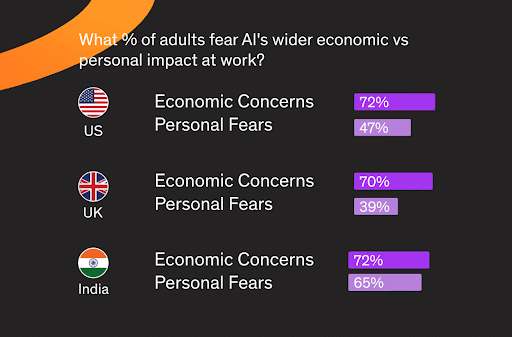
When it comes to career planning in an increasingly AI-driven world, our human bias towards optimism could be creating a harmful blind spot. In new Udemy research, conducted by YouGov, we surveyed adults in four major economies to uncover trends in career skills readiness. One of the trends we found: across all economies, people were more concerned about the impacts of AI on the broader economy, and less concerned about its impact on their personal job and livelihood. Though we can’t say for sure why we see this disconnect, it suggests some evidence of optimism bias – a psychological pattern that could leave millions of workers underprepared for the changes ahead.
Optimism bias is our tendency to believe that while bad things happen in the world, they’re less likely to happen to us personally. These biases are pervasive and can show up in a wide range of contexts, including workplace settings. It’s why we may think layoffs will happen to other departments, budget cuts will affect other teams, and industry disruption will impact other companies.
While it sounds irrational, optimism bias serves a purpose: it can soothe anxiety, motivate us, and keep us confident as we navigate our daily lives in a chaotic world. However, it can also lead us to ignore risks and make poorer choices, leaving us unprepared when big, unexpected changes do happen.
The AI Optimism Bias
Udemy’s data suggests adults worry more about AI’s impact on the broader job market than on their own careers. This pattern is most pronounced in the US and UK, where workers are 1.5 to nearly 2 times more likely to fear an economy-wide job impact than a personal career impact. Workers in these markets acknowledge they lack essential AI capabilities, such as learning AI tools and incorporating AI into workflows. Yet, they’re also not taking advantage of available training, with over half of UK workers and nearly half of US workers pursuing no AI upskilling. In contrast, adults in India* show nearly equal concern for both economy-wide and personal AI impacts and pursue training at significantly higher rates, suggesting there could be a link between more balanced threat assessment and proactive preparation.
This raises the question: how do we bridge awareness of impact and readiness for impact? Here are some ways you can look optimism bias in the face and stay one step ahead:
- Consider an outside view. Before making a decision based on your unique circumstances, consider how AI disruption has impacted others in similar careers. You can also reach out to your professional network about AI adoption at their companies. Often, the impact feels more real when you hear details from people you know.
- Map your daily tasks. List your main tasks at work and research which specific AI tools can already perform these functions to get a more realistic sense of how vulnerable you are to disruption.
- Prepare for every outcome. Develop multiple scenarios (optimistic, realistic, pessimistic) when it comes to the potential for AI to impact your career, and plan for each. That way, you’ll have a playbook for any challenge you may face in the future.
- Experiment with AI tools in your workflow. Our data found that the majority of workers report a lack of adequate AI skills, with top deficiencies in practical areas such as learning AI tools and incorporating AI into workflows, despite acknowledging AI’s productivity benefits. Once you know which AI tools are available, start thinking about how to plug them into your daily work.
Practice non-AI skill sets in tandem with AI. While adults acknowledged their shortcomings in AI skills, entry-level workers in particular tended to vastly overestimate their adaptive skills (or soft skills) readiness. Both AI skills and adaptive skills are essential for career success.
Learn From The Past, Prepare For The Future
History offers crucial lessons about how workforces respond to technological disruption. Consider, for example, the internet’s effect on traditional print news media. While journalists saw this disruption coming like workers do today with AI, they found themselves trapped by business model collapses beyond their individual control. Many paid the price with job losses and career impacts that continue to echo today. Today’s workforce faces a similar scenario with important distinctions. While we’re also staring down a massive disruption, workers around the world have unprecedented access to learning resources that can help them build a more secure future.
The key is to find a balance between the delusions of optimism bias, while staying open to the career possibilities that emerge when you prepare for what’s next. Instead of listening to the inner voice that says, “It’ll never happen to me,” we can ask
*In India, the sample is nationally representative only of adult internet users between the ages of 18 and 70. This differed from the samples from the US and UK which is nationally representative of adults between the ages of 18 and 70.