

Article Summary
Prompt chaining is a prompt engineering technique that breaks complex AI tasks into smaller, sequential steps where each output feeds the next. This article covers how it works, its key types, real-world use cases, and how to design effective chains. You'll gain the knowledge to build smarter, more reliable AI workflows.
Prompt chaining is a prompt engineering technique that enables you to use AI to break a complex task into small, interconnected steps. This guide explains everything you need to know about prompt chaining, including what it is, why it’s important, how it works, and how to learn prompt chaining skills.
What Is Prompt Chaining?
Prompt chaining is a structured, sequential approach to prompt engineering. Instead of using a single, large prompt, you use multiple smaller ones. Breaking it down into smaller sequential prompts helps you get accurate and contextually relevant results.
To create a prompt chain:
- Take a large, complicated task and break it down into multiple subtasks.
- Make a prompt for each subtask.
- Execute each prompt as part of a sequence.
- The output for a completed task becomes the input for the next.
For example, consider this scenario using ChatGPT for data analysis: You have a dataset of customer purchases and want to analyze trends, generate insights, and provide three recommendations to your leadership team. Instead of giving one giant prompt, you can chain multiple prompts together to guide the AI step by step.
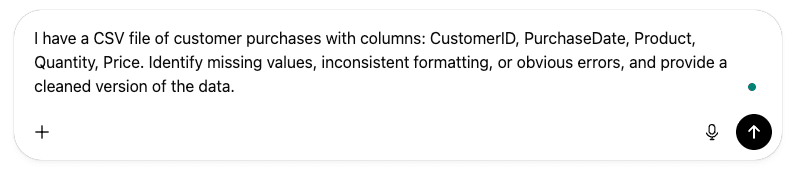
The process can be interactive, and you can tweak a prompt to refine the output and improve the large language model’s (LLM) performance. Think of prompt chaining in the same way people solve problems. Start with addressing the small things first and continue to build until you have a complete solution.
In the data analysis scenario, we can create a second prompt to perform additional calculations, for example: Using this cleaned dataset, calculate the total sales per month and the top 5 best-selling products. Provide the results in a table.

Rather than try to tackle a major problem all at once, you may break it down into a series of small steps. With each step you complete, you move one step closer to getting the optimal outcome.
Continuing with our prompt chain example, we input the next prompt: Analyze the monthly sales data. Identify any trends, seasonal patterns, or anomalies in sales over time.
After receiving an overview of trends, we enter the final prompt in the chain and achieve our goal outcome: personalized recommendations based on unique sales data.
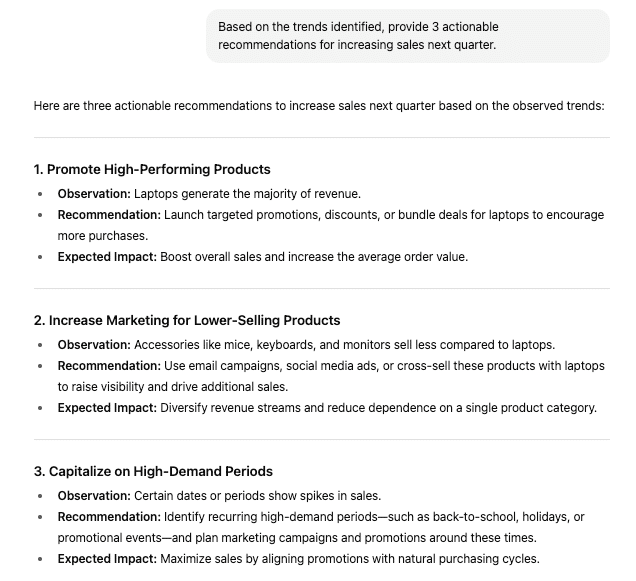
Without using a prompt chain, tools like ChatGPT are more likely to misunderstand the request, make contextual errors, or generate hallucinations. If the steps in a prompt chain are instead combined into a single prompt, the model may produce code or outputs that don’t align with the intended context. Take a look at what happens when we combine the prompts in our prompt chaining example into a single prompt – ChatGPT misunderstands the request and generates code instead:
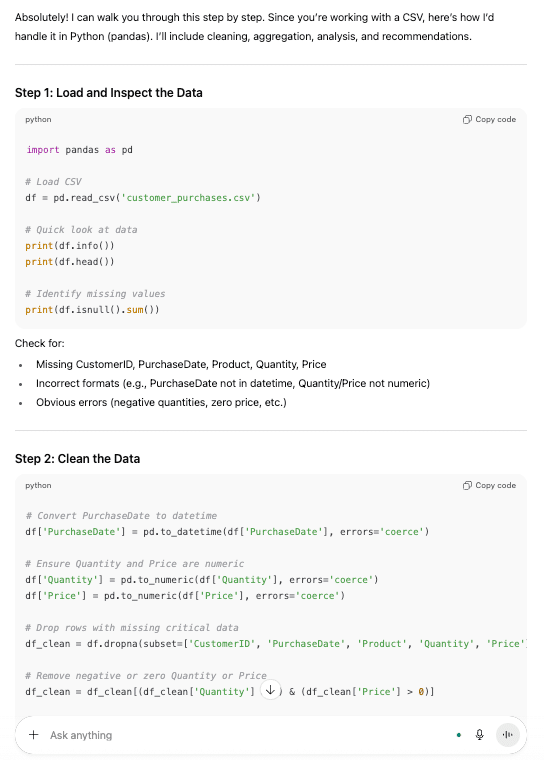
Today, content creators, developers, data analysts, and many others rely on prompt chaining. This technique improves consistency and reduces hallucinations, which tend to happen with large, complex prompts. It also supports applications involving logic, planning, data processing, and code generation.
Why Prompt Chaining Matters in 2025
Prompt chaining is a game-changer for many people and businesses around the world. Some reasons people have embraced prompt chaining include improved AI performance, enhanced workflows, and increased reliability.
Better LLMs
While Claude, Gemini, ChatGPT, and other open-source LLMs can handle complex tasks, they don’t always do it well. Think of it like following a recipe. If you follow the recipe exactly, you’ll get a good meal you can sink your teeth into.
However, if you have a long recipe with countless instructions, you might forget an ingredient or a step along the way, and what you wind up with might not be ideal. The same is true with AI.
If you provide a long, complex prompt with too many steps, the AI model is likely to forget some of the instructions, and the output won’t be what you’re looking for. If you throw too many instructions into the pot, something’s bound to go wrong.
But when you guide these and other modern AI tools step by step with prompt chaining, they can better handle complex reasoning. They can digest each instruction, completing only that task, before moving on to the next one. Chain prompting helps these tools analyze information, apply logic, and make sound decisions.
Scalable and Accurate Workflows
In May 2025, PwC released an AI agent survey featuring insights from 300 senior executives. Key takeaways included[1]:
- 88% of senior leaders said their team or business function intends to increase their AI-related budgets in the next 12 months due to agentic AI.
- 79% noted that their companies have adopted AI agents.
- 66% indicated that their AI agents are delivering measurable value by helping their companies increase productivity.
Prompt chaining can develop and maintain scalable and accurate workflows for AI agents, which more companies could adopt in the foreseeable future. These workflows can adapt to dynamic environments and help AI agents, copilots, and autonomous systems achieve their goals with little to no human intervention.
Improved Reliability
Stepwise prompting, which involves outlining multiple steps for an LLM to follow instead of setting up separate prompts, can cause reliability issues. A June 2024 study from Cornell University suggested that prompt chaining may be a better option than stepwise prompting in terms of reliability[2]. In the study, researchers noted that prompt chaining may help with drafting, critiquing, and refining prompts.
According to the study, if you use prompt chains to create reliable prompts, you may get more accurate results than you would with stepwise prompting. Prompt chaining can also reduce prompt length issues and boost success rates.
This technique is already utilized in real-world tools built with LangChain, CrewAI, LlamaIndex, ReAct, and many others. It can connect multiple prompts in a sequence to improve response quality and accuracy. Prompt chains can also link prompts through a pipe operator to manage the flow of data between them.
Types of Prompt Chaining
Because prompt chaining isn’t a one-size-fits-all solution, there are many approaches you could take.
Sequential Chaining
Sequential chaining is ideal for writing, code generation, and form-filling workflows. With sequential chaining, you break an LLM prompt down into small, interconnected steps, and one prompt feeds into the next. Handling the steps sequentially gives you more control over the LLM prompt and reasoning process, making it easy to generate detailed and relevant solutions to sophisticated problems.
Branching Trees
Sometimes called Tree of Thought (ToT) prompting, this involves using LLMs to solve problems the same way you would. You provide a prompt with criteria for output branches, and you get a series of decision-making flows.
For example, let’s say you use a prompt to encourage a model to consider various solutions to a problem. This results in a branching, tree-like structure of thoughts. At this point, you can explore parallel reasoning paths simultaneously.
Refinement Loops
Refinement loops are commonly used for content polishing, summarization, or code optimization. Create an LLM prompt, then feed it into a new one, which will critique, revise, and refine it. You can keep the loop going until you achieve your desired output quality.
Parallel Chaining
Parallel chaining allows you to run multiple prompts to complete different parts of a large task simultaneously. Then, all the chains come together to produce the final output.
Use Cases for Prompt Chaining
Prompt chaining has proven to be beneficial in the following use cases.
Multistep Content Creation
Create a blog post, article, or other content step by step using large language model prompts. This quick and simple process allows you to produce content that’s timely, accurate, and resonates with your audience.
First, use a large language model prompt to research content topics. Once you have a list of topics, choose one, and use a second LLM prompt to produce an outline. Then, submit a third prompt to draft the content section by section.
After you have a content draft, refine it using prompts. Finally, publish your content, track its performance, and continue to use prompt chains to develop future content that generates traffic and expands your global reach.
Tools like Lovart.ai showcase this approach in action, using a well-designed system prompt to guide the entire multistep creation process.
Chatbot and Agent Design
Prompt chaining provides a roadmap for designing chatbots and agents. With that roadmap, you can account for user queries, classification, retrieval, and response formatting. This allows you to build a chatbot or agent that’s less likely to make mistakes or miss details.
With prompt chains, you can see how your chatbot or agent analyzes and responds to user queries. Then you can identify and address any issues before it goes live.
Prompt chaining also helps you improve the user experience. It allows you to use trial-and-error to fine-tune your chatbot or agent until it provides users with amazing experiences.
Data Transformation
Prompt chains simplify the process of parsing through massive volumes of structured and unstructured data. You can use an LLM prompt to search for the data you need and generate actionable insights.
It lets you separate structured data from unstructured data. You’ll be able to validate accurate and reliable data and remove any that’s not from your collection.
Prompt chaining also supports data analysis. You can use LLM prompts to summarize your data into key findings or get suggestions for data visualizations.
Coding
You can use prompt chains to write pseudocode. If the pseudocode performs as expected, you can continue with prompt chains to convert it into code, test it, and debug it.
If you have code that’s not working correctly and aren’t sure why, prompt chains can help you get to the root of the problem. And if you detect code problems as you’re using prompt chains, you can utilize LLM prompts to resolve these issues.
Teaching and Training
Many teachers use prompt chains and LLM prompts to improve the learning experience. For example, if you want to teach students about a difficult topic, you can use prompt chains to find ways to define the concept behind it. These chains can help you come up with examples relating to the concept, quiz students on it, and provide them with feedback.
Companies also incorporate prompt chains into training development. They’re using LLM prompts to understand how employees will view various training materials and develop or update them accordingly. These prompts enable businesses to create quizzes, games, and other training programs to help their staff learn and thrive.
Decision Support
Prompt chaining lets you evaluate evidence as you make a decision, weigh the pros and cons of any choice you make, and get personalized recommendations. As such, it helps you make fast, informed decisions that deliver outstanding results.
Prompt chaining is incredibly valuable to business leaders who want to get their point across in a meeting. If you want to explain why your company should make a decision, you can use LLM prompts to get insights to support your argument. This can help you feel confident when you present your case and boost the likelihood that they’ll consider what you have to say.
How to Design a Prompt Chain
Follow these steps to design an effective prompt chain:
- Define your goal: Consider what you want to achieve. Why are you using prompt chains, and what’s the final output you’re looking for?
- Break it down: Make a list of steps to be handled separately.
- Design each prompt: For each task, create a specific prompt that explains what you want AI to produce, context for the steps, and details about the output format, tone, and style.
- Test each link: Test each prompt in your chain to ensure it delivers the results you want. You should also evaluate your chain against your original goal.
- Chain with tools: Take advantage of LangChain, CrewAI, or other simple scripts to pass outputs between prompts.
- Add controls: Consider how conditions, loops, memory, or retries might impact your prompts. They can help you make your chains more robust.
How Udemy Helps You Apply Prompt Chaining in Real Workflows
Udemy’s courses give you access to the tools and resources you need to master prompt chaining and other aspects of prompt engineering.
Enroll in our ChatGPT and prompt engineering courses to learn how to design prompt chains for actual business use cases. In our courses, you’ll practice prompt chaining with GPT-5, Claude, and open-source LLMs. Hands-on projects include chatbots, writing assistants, and code generation pipelines.
Enroll today to start your prompt chaining adventure.
Sources:
[1] https://www.pwc.com/us/en/tech-effect/ai-analytics/ai-agent-survey.html
[2] https://arxiv.org/abs/2406.00507