

Article Summary
The most valuable AI skills aren't just technical, they're about knowing how to collaborate with AI while keeping your judgment intact. This article covers prompt refinement, delegating tasks effectively, and using AI across creative and business workflows. This is an interview with Canva Verified Experts and Udemy Instructors, Team RonDi.
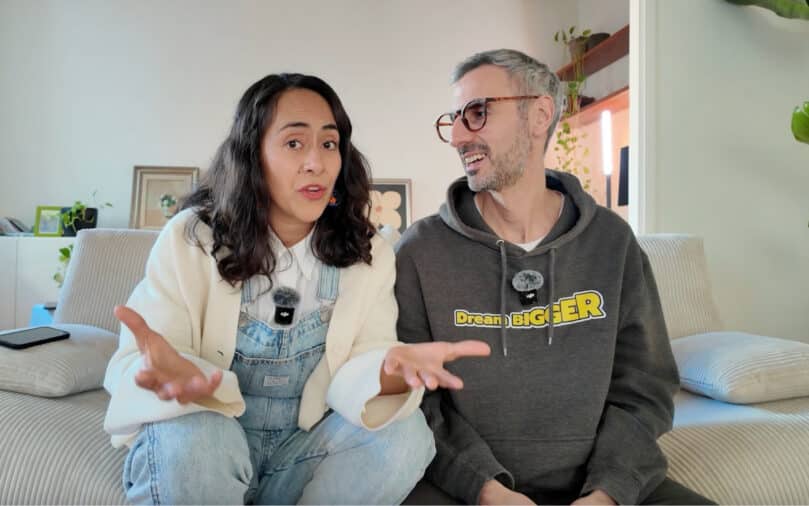
Meet Ronny and Diana, better known as Team RonDi, who’ve taught more than 230,000 students and earned 25,000+ reviews teaching right here on Udemy. The husband-and-wife duo are two of only 45 Canva Verified Experts in the world, hand-picked by Canva, with Ronny having spent two years working inside Canva’s own community and Design School teams.
Canva is still at the heart of everything they teach, but they’ve been leaning hard into AI too, finding ways to pair it with creative workflows that actually work for creators and entrepreneurs. We asked them about the AI skills worth learning, the misconceptions holding people back, and where they see AI taking design and creativity next.
What is one AI skill everyone should learn right now?
Everyone is using AI, but very few people know how to use it without handing over control.
The human should still be the starting point. We bring the idea, the intention, the experience, and the judgment. We should also remain the final decision-maker. AI sits in the middle of that process and helps us think, research, organize, write, analyze, or create faster.
Using it well requires much more than knowing how to type a prompt. You need to understand your own strengths and weaknesses, and you need to learn how to delegate clearly: explain the task, provide enough context, define the audience, and ask for a specific output.
But perhaps the most important part is learning to push back. The first answer an AI gives you is often generic, predictable, or just slightly off, but it usually looks finished. That polish is exactly what tricks people into copying, pasting, and hitting send too early.
Canva’s co-founder Cameron Adams calls this “the last mile”:
AI can get you 80% of the way there fast, but the part that makes the work sharp, personal, and trustworthy is the stretch humans still have to walk themselves. The AI draft is raw material, not the result.
So be comfortable saying, “No, that doesn’t sound like me,” or “You missed the point.” Ask it to try again. Have a genuine back-and-forth until the output reflects your ideas, your voice, and your personality.
The real skill is not simply learning how to use AI. It’s learning how to collaborate with it while keeping your judgment, personality, and humanity firmly in the driver’s seat.
What is a common misconception about AI?
That it is primarily a threat.
The concerns are not completely irrational. AI will change jobs, reshape industries, and automate some of the work people currently do. But fear often stops people from discovering how useful AI can be when it is placed in their own hands.
We have seen this shift many times during AI training sessions with entrepreneurs and small teams. At the beginning, people are often cautious. Some worry AI will make their role less valuable. Others have tried ChatGPT once, received a generic answer, and concluded the whole thing is overhyped.
Then we start working through real examples from their day-to-day jobs – reading through a contract, preparing for a negotiation, drafting a delicate email, turning messy notes into a clear action plan. And then comes the moment we always look for. Their expressions change. “Wait… it can do that?”
In less than two hours, someone can move from AI skeptic to AI enthusiast. Not because we convinced them with a grand speech about the future, but because they saw it solve a real problem in their own work.
AI should be questioned. Its outputs should be checked, and its limitations taken seriously. But refusing to explore it will not protect us from the changes it may bring. In our experience, fear rarely disappears because someone tells you not to worry. It disappears the moment you say, "Wow, I could actually use this."
How are you personally using AI in your day-to-day work?
AI has become woven into almost every part of our day-to-day work, but rarely in the way people imagine. We do not wake up, press a button, and ask AI to do our job for us. We use it more like an extra brain in the room. One that is always available, never gets tired, and is surprisingly comfortable jumping between a course curriculum, a client proposal, a YouTube video, and a complicated email within the same conversation.
We often start by giving it something messy: a voice note, a half-formed idea, student feedback, or a problem we have been turning over in our heads. Then we work through it together. Sometimes we need help structuring our thinking. Other times, we want the AI to challenge an idea, find the gaps in our reasoning, or play a role: a student, a potential client, a skeptical viewer, or even someone negotiating against us.
In course creation, we use AI to analyse student reviews, audit existing curricula, identify outdated lessons, and develop exercises and quizzes. For YouTube, it supports almost every stage: researching new Canva and AI features, testing video angles, developing titles and thumbnails, turning rough notes into a clearer script. But the opinion, the teaching, the stories, and the final creative decisions still come from us.
On the business side, AI helps us prepare for client calls, review contracts, think through pricing, and write delicate emails where the tone really matters.
We work across ChatGPT, Claude, Gemini, Perplexity, and the growing range of AI features inside Canva. Different tools are useful for different jobs. The most valuable use, though, is probably the simplest: AI helps us move from a vague thought to something we can actually ship. A blank page is difficult. An imperfect draft is much easier to work with.
What is one tool or workflow you recommend starting with?
Start with a task you regularly have to do but keep putting off because it drains you. Maybe it is writing a long email, reading through a contract, analyzing data from your YouTube channel, comparing products before making a purchase, or structuring an important slide deck.
Pick one task and ask: how could AI help me do this faster or with less friction? It might get you 80% of the way there. It might produce a first draft, summarise the key information, compare your options, or organize everything into a format you can actually use.
You will still need to review the result, make decisions, and add your own judgment. That is fine.
The goal is not to remove yourself from the equation. The goal is to make an annoying task lighter.
And once you experience that first win, when something that normally takes an hour suddenly takes 15 minutes, you start to understand where AI fits into your work.
What advice would you give someone just getting started with AI?
Simple: call the person in your network who is most excited about AI and ask them to spend an hour showing you why. Not giving you a formal lesson. Not walking you through 50 different tools. Just showing you how they actually use AI in their own work and why they cannot stop talking about it.
Enthusiasm is contagious. When someone treats AI like a superpower, they naturally start showing you the interesting stuff. And at some point, they will demonstrate something that connects directly with your own life or work. That is when the shift happens. You stop thinking, “AI seems complicated,” and start thinking, “Wait, could it help me with this?”
People rarely become excited about AI because someone explained the technology behind it. They become excited when they see it solve a problem they personally recognize.
With Canva at the heart of your work, how do you see AI shaping the future of design and creativity for creators and entrepreneurs?
AI is reshuffling the entire creative process: generating images, videos, websites, and entire creative directions from a conversation. Tools like Canva are bringing all of this into one workspace, and as Canva Verified Experts, we’ve seen firsthand how Canva is working to position AI as a true creative partner.
That creates opportunity, but it also raises the bar. When everyone has access to the same tools, the value shifts to how you use them. Every creator should be able to answer: what do I have that somebody else using the same AI cannot easily copy? Maybe it’s your taste, your experience, your sense of humor, or simply the gut feeling that tells you one idea is worth pursuing and another should go straight into the bin.
AI can generate endless options. It cannot decide what you want to stand for.
Our advice: dedicate regular time to learning these tools: buy a course on Udemy, choose one, and spend a day exploring how it fits your workflow. And don’t learn alone. Talk to other creators, compare notes, and join a community experimenting with the same tools. The irony is that the more AI becomes part of creative work, the more valuable real human interaction becomes.
Ready to get scary good at Canva? Explore Team RonDi’s instructor profile on Udemy and start with their flagship Canva Master Course, which takes you from the basics to fully confident, with real projects and feedback along the way.