

Article Summary
Large language models are AI systems that predict and generate text by recognizing patterns learned from massive datasets. This article covers how LLMs work — from tokens and embeddings to transformer architecture, training stages, and real-world applications. Readers will gain a clear, no-code understanding of LLMs and how that knowledge applies across careers.

Artificial intelligence has moved from something abstract and experimental to something people interact with every day. You might use AI to draft an email, summarize a long document, brainstorm ideas, or ask questions you would normally type into a search engine. Behind many of these tools are large language models, often referred to as LLMs.
For beginners, LLMs can feel mysterious. They respond fluently, adapt to tone, and are changing the way we search for answers and work through our day-to-day lives. Understanding how LLMs work matters more than ever. These models are influencing careers in marketing, education, healthcare, software development, finance, and many other fields. Having foundational knowledge can help you apply AI tools more effectively, ask better questions, and recognize their limitations.
This beginner’s guide explains what large language models are, how they work, where they are used, and much more, so you can set up great baseline knowledge to build upon. Then, you can continue learning through accessible courses on Udemy.
What Are Large Language Models (LLMs)?
Large language models are AI systems trained to work with human language. They are designed to read, interpret, and generate text in a way that feels natural to humans. Unlike traditional software that follows fixed rules, LLMs learn patterns from data.
Much of the early research that led to modern LLMs came from attempts to improve machine translation. Researchers needed systems that could understand relationships between words across entire sentences, rather than translating word by word. This challenge eventually led to new neural network architectures that could analyze language more holistically.
Today’s LLMs build on those ideas. Instead of relying on hard-coded rules, they learn statistical patterns from massive datasets, allowing them to generate language that feels flexible, contextual, and human-like.
An easy way to think about an LLM is as a system that answers the question:
“Given everything I’ve seen so far, what is the most likely thing to come next?”
When you type a sentence or a question into an AI tool, the model does not look up a stored answer. Instead, it builds a response by analyzing patterns and data and predicting the answer one piece at a time..
Some widely used LLMs you may recognize include:
These models power chatbots, writing assistants, code helpers, tutoring tools, and enterprise software across industries. We will explain how LLMs work, what they are capable of, and where they need additional guidance from users. We will also use the analogy of LLMs as interns, helpful but inexperienced assistants who need a little guidance so they can help with clearly defined tasks.
Beginner Level: A Simple Way to Understand LLMs
At a baseline/beginner level, an LLM can be described very simply: A large language model is trained to predict the next word in a sentence based on patterns it learned from massive amounts of text.
For example, if you type:
“Learning how AI works can help you…”
The model might complete the sentence with:
“understand modern tools, improve productivity, and make better decisions.”
It chooses this continuation because similar phrases appear frequently in its training data. In many ways, this is a more advanced version of the autocomplete feature on a smartphone keyboard. Instead of suggesting the next word based on a few recent messages, an LLM draws from patterns learned across enormous datasets. The model is not reasoning or forming opinions; it is identifying patterns that statistically make sense.
This pattern-based approach is what allows LLMs to:
- Answer questions
- Continue stories
- Summarize articles
- Rewrite text in different tones or even different languages
Intermediate Level: Context and Coherence
At an intermediate level, a large language model can be understood as a system that uses context to guide its predictions. LLMs are doing more than predicting isolated words. Instead of predicting isolated words they consider context across entire sentences and conversations.
This is why you can ask follow-up questions, request clarification, or ask the model to change its tone. The model keeps track of what has already been said and adjusts its responses accordingly. However, context must still be relevant. Providing too much information, or including unrelated details, can sometimes make responses less accurate or focused.
For example, if you ask an AI tool to explain something “like I’m five,” it will simplify its language. If you later ask for a “more technical detailed explanation,” it adapts again. This flexibility comes from its ability to model relationships between words and ideas across longer stretches of text.
Advanced Level: A More Technical View
At a more advanced level, LLMs are described as neural networks built using transformer architectures. Transformers allow models to process entire blocks of text simultaneously rather than one word at a time. This makes them faster, more scalable, and better at understanding long-range context.
While this description sounds technical, the key takeaway is simple: transformers are what make modern language models powerful and efficient compared to older approaches.
Beginner Level: A Simple Way to Understand LLMs
At a baseline/beginner level, an LLM can be described very simply: A large language model is trained to predict the next word in a sentence based on patterns it learned from massive amounts of text.
For example, if you type:
“Learning how AI works can help you…”
The model might complete the sentence with:
“understand modern tools, improve productivity, and make better decisions.”
It chooses this continuation because similar phrases appear frequently in its training data. In many ways, this is a more advanced version of the autocomplete feature on a smartphone keyboard. Instead of suggesting the next word based on a few recent messages, an LLM draws from patterns learned across enormous datasets. The model is not reasoning or forming opinions; it is identifying patterns that statistically make sense.
This pattern-based approach is what allows LLMs to:
- Answer questions
- Continue stories
- Summarize articles
- Rewrite text in different tones or even different languages
Intermediate Level: Context and Coherence
At an intermediate level, a large language model can be understood as a system that uses context to guide its predictions. LLMs are doing more than predicting isolated words. Instead of predicting isolated words they consider context across entire sentences and conversations.
This is why you can ask follow-up questions, request clarification, or ask the model to change its tone. The model keeps track of what has already been said and adjusts its responses accordingly. However, context must still be relevant. Providing too much information, or including unrelated details, can sometimes make responses less accurate or focused.
For example, if you ask an AI tool to explain something “like I’m five,” it will simplify its language. If you later ask for a “more technical detailed explanation,” it adapts again. This flexibility comes from its ability to model relationships between words and ideas across longer stretches of text.
Advanced Level: A More Technical View
At a more advanced level, LLMs are described as neural networks built using transformer architectures. Transformers allow models to process entire blocks of text simultaneously rather than one word at a time. This makes them faster, more scalable, and better at understanding long-range context.
While this description sounds technical, the key takeaway is simple: transformers are what make modern language models powerful and efficient compared to older approaches.
Core Concepts Made Simple
Many explanations of LLMs rely heavily on equations and engineering diagrams. For beginners, however, it is more helpful to focus on understanding the building blocks and the ideas behind the technology rather than the math.
Tokens
Tokens are small pieces of text, such as words, parts of words, or punctuation, that the model processes instead of full sentences. Breaking language into tokens allows the model to handle text consistently, no matter how long or complex it is.
Embeddings
Embeddings convert tokens into numbers that represent meaning. Words or phrases with similar meanings end up closer together in this numerical space, helping the model recognize relationships between ideas.
Transformers
Transformers are the underlying architecture that allows the model to analyze all parts of a sentence at once. After tokens are converted into numerical representations, transformers analyze those embeddings together to understand how they relate to one another across an entire sentence or passage. This makes it possible to understand context, connections, and emphasis across longer pieces of text, as well as how ideas relate across long pieces of text.
Instead of reading text word by word, transformers compare all embeddings at once. This allows the model to understand context, track relationships between ideas, and determine which parts of the input are most important. As a result, the model can recognize meaning that depends on surrounding words, earlier sentences, or the overall structure of the text.
Attention mechanisms
Attention mechanisms help the model decide which words matter most when generating a response. This is similar to how people focus on keywords when reading.
How Generative AI Models Work
Large language models belong to a broader category called generative AI, which refers to systems that can create new content rather than simply classifying or retrieving existing information.
Traditional AI systems were often designed for narrow tasks. For example, an AI might be trained only to recognize faces in photos or flag fraudulent transactions. Generative AI systems, by contrast, are flexible. The same model can write text, answer questions, summarize content, and adapt to new instructions.
This flexibility is one of the biggest reasons LLMs have become so influential.To understand where LLMs fit within the broader AI landscape, and how it’s affecting careers, this explainer is a useful reference: Machine Learning vs AI: Career Skills and Opportunities.
Foundation Models: The Backbone of Generative AI
LLMs are often described as foundation models. A foundation model is trained once on an enormous dataset and then reused across many tasks.
You can think of a foundation model like a general education. First, it learns grammar, facts, reasoning patterns, and language structure. After that, it can be trained and adapted for specific roles, such as customer support, coding assistance, or tutoring.
This differs from older AI systems, which often needed to be trained separately for each task.
How are LLMs Built?
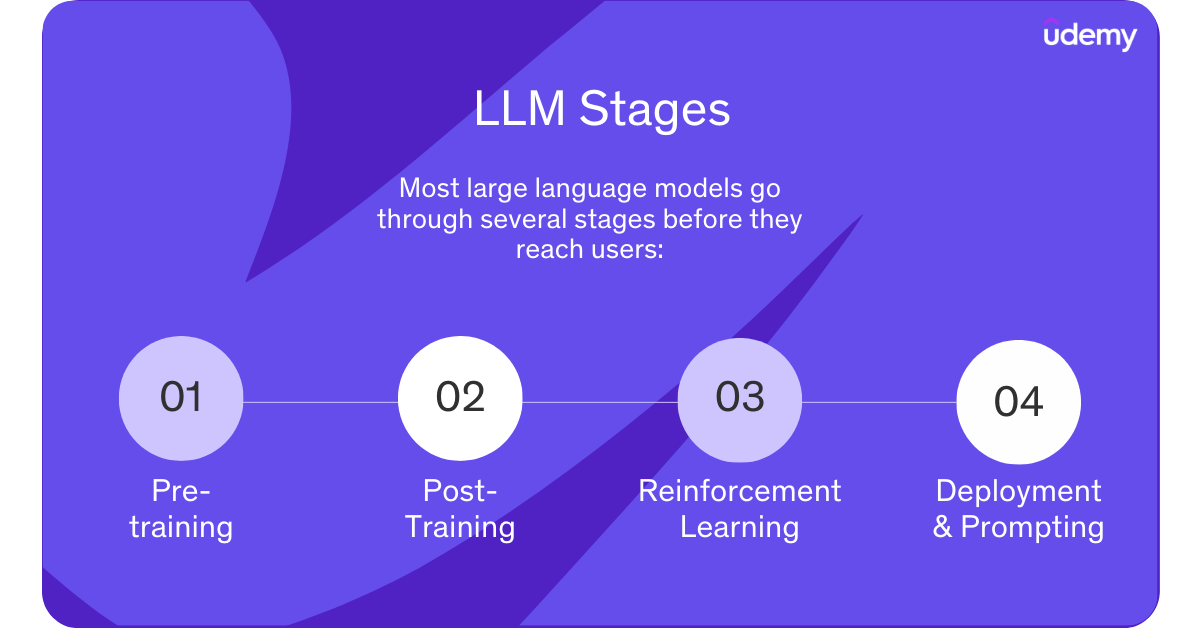
Most large language models go through several stages before they reach users:
Pre-training
During pre-training, the model processes vast amounts of text from books, articles, websites, and other sources. It learns how language works at a broad level, including grammar, vocabulary, and factual concepts. This initial process breaks language down into tokens and embeddings where words and ideas are related to each other. If we go back to our intern analogy, this is the childhood education that provides an intern with knowledge about the world but little experience in how to apply it.
This is also the most intensive part of the process as it requires acquiring and licensing massive amounts of content and harnessing over 100,000 processors to assemble the base model. For this reason most base models are only developed by large enterprises like OpenAI, Anthropic and Google.
Post-Training
Once a base language model is pre-trained, the creators (or another organization) need to align it to their specific use case.
One method for doing this is Supervised Fine-Tuning, which provides examples of desired output, guardrails around undesirable or dangerous behavior, and the conversational tone a model should respond with. Supervised fine tuning can be used to optimize a model for friendly conversation, or specific tasks like agentic tool use, reasoning, or coding assistance. Back to our intern, supervised fine-tuning is the manual or playbook of how to do a job.
Reinforcement Learning
Another common method for refining a base model is Reinforcement Learning, which iteratively improves responses based on positive/negative feedback (reinforcement). Humans or automated systems rate outputs, helping the model learn which responses are more useful or appropriate. This differs from fine-tuning because the model is allowed to optimize itself without targeting specific behaviors/examples. For an intern, this would look like performance reviews to reduce bad habits and encourage preferred behavior.
Deployment & Prompting
Once trained, the model is integrated into applications where people interact with it. At this stage, additional safety measures, performance optimization, and user experience become critical. Providers build conversational interfaces, tools like web search, and user personalization to make LLMs applicable for daily use.
Once an LLM is in the user’s hands, it’s up to them to provide prompts or instructions on what you want it to do and how you want it to respond. Prompting is also an important step for preventing hallucinations, or confident-sounding mistakes when missing context. Interns aren’t great about self awareness under pressure, so give it context/constraints and verify outputs when stakes are high.
Applications of LLMs and Generative AI
Large language models are already embedded in tools people use every day:
- In chatbots and virtual assistants, LLMs answer questions and handle routine support requests.
- In content creation, they help draft articles, summarize reports, and brainstorm ideas.
- In education, they support tutoring, explanations, and personalized learning paths.
- In healthcare, they assist with documentation and research analysis.
- In finance and marketing, they help analyze reports and generate communications.
As models improve, these applications continue to expand into new industries.
What Types of Careers Are Relevant to LLM Building?
LLM-related careers span technical, semi-technical, and non-technical roles. As generative AI becomes embedded in everyday tools, a conceptual understanding of how LLMs work helps people make better decisions about how these systems are built, used, and evaluated.
AI and Machine Learning Engineers
These professionals design, train, and optimize large language models. Their work involves building neural networks, managing large datasets, and improving performance and efficiency. While this path requires advanced technical skills, beginners benefit from understanding the conceptual side of LLMs before diving deeper.
Data Scientists and Analysts
Data professionals help prepare, evaluate, and analyze the information LLMs rely on. They assess data quality, monitor outputs, and help organizations interpret model results responsibly. Understanding LLM behavior helps data professionals identify bias, limitations, and appropriate use cases.
Software Developers and Engineers
Many developers now integrate LLMs into applications using APIs rather than building models from scratch. Developers use LLMs to assist with coding, debugging, documentation, and user-facing features. Knowing how LLMs generate text helps developers design better prompts and workflows.
Product Managers and Designers
Product leaders shape how AI-powered features are used by real people. They decide where LLMs add value, define ethical boundaries, and ensure usability. A conceptual understanding of how LLMs work enables better decision-making and collaboration with technical teams.
Educators, Writers, and Knowledge Workers
LLMs are increasingly used in education, research, and content-heavy roles. Teachers, instructional designers, marketers, journalists, and analysts benefit from knowing how models generate and summarize information—and where human judgment remains essential.
The key takeaway is simple: you don’t need to build LLMs to benefit from understanding them. Foundational knowledge makes you a more effective collaborator, user, and decision-maker in an AI-driven environment.
Learning AI Concepts
For beginners, the biggest challenge is knowing where to start. Many online explanations of AI assume technical backgrounds or jump too quickly into complex math. Udemy’s beginner-focused AI courses are designed to lower that barrier.
Beginner-Friendly Learning Paths
Courses like Generative AI for Beginners and AI for Beginners focus on concepts first—what AI is, how it works, and how it’s used—before introducing tools or applications. This approach builds confidence and reduces intimidation.
You can explore these beginner paths here:
Understanding LLMs Without Coding
If you want to specifically understand large language models, Udemy’s Intro to Large Language Models (LLMs) course provides a structured overview without requiring advanced programming knowledge. This is especially helpful for professionals who want clarity rather than technical depth.
Course highlight: Intro to Large Language Models (LLMs)
Learning by Doing
Many Udemy courses include hands-on exercises, demonstrations, and real-world examples. This helps learners move from abstract understanding to practical application—such as experimenting with prompts, comparing model outputs, or exploring ethical considerations.For those curious about how different models compare in practice, this article is a helpful complement: Claude vs ChatGPT: Which AI Tool is Best?
FAQs for Beginners
Do I need to know how to code to understand LLMs?
No. While coding can help you build and integrate models, understanding how LLMs work conceptually does not require programming. Many professionals benefit simply from knowing how models generate text, what they can and cannot do, and how to interact with them effectively.
How do LLMs differ from other AI models?
Traditional AI systems are often designed for narrow tasks, such as classification or prediction. LLMs are generative, meaning they create new content. They are also trained on broader datasets and can perform many tasks using the same underlying model.
For a deeper comparison, this explainer is useful: Machine Learning vs AI: Career Skills and Opportunities
How can beginners apply AI and LLMs in their careers?
Beginners often start by applying AI knowledge within their existing roles—using LLMs to improve productivity, research, communication, or analysis. Over time, some learners transition into AI-adjacent roles such as product management, data analysis, or AI operations.
Common Misunderstandings About LLMs and Generative AI
As AI tools become more visible, misconceptions can spread quickly. Clearing these up helps beginners develop realistic expectations.
Myth: LLMs “know” facts.
Reality: LLMs do not understand or verify information. They generate responses based on patterns, not verified truth. This is why outputs must be reviewed carefully, especially in professional contexts.
Myth: LLMs are neutral or unbiased.
Reality: Because LLMs learn from existing data, they can reflect biases present in that data. Human oversight remains critical.
Myth: AI makes human skills less important.Reality: As AI tools become more capable, human skills like critical thinking, communication, and ethical judgment are becoming more valuable, not less.
Next Steps: Start Exploring AI and LLMs Today
Understanding how large language models work is no longer just for technologists. It is becoming a foundational literacy for professionals across industries. The good news is that you can start learning without a technical background, advanced math skills, or years of study.
Begin by focusing on concepts, not complexity. Learn what LLMs are, how they generate text, and where they are used. From there, explore practical tools and courses that align with your goals.
Udemy’s AI learning resources make it easy to take the next step—whether you want a high-level understanding, hands-on practice, or a pathway toward deeper expertise. You can also explore how AI skills support long-term career resilience in this related guide: How Learners Are Future-Proofing Their Careers With AI and Cloud
Large language models are shaping how people work, learn, and communicate. By understanding them early, you position yourself not just to keep up—but to use AI thoughtfully, responsibly, and effectively in whatever career path you choose.