

Article Summary
AI regulation is reshaping the job market, creating demand for roles like AI Ethics Officer, Compliance Engineer, and Policy Specialist. This article covers which industries are most affected, what skills employers now require, and how global rules like the EU AI Act are driving hiring shifts. You'll gain a clearer picture of where AI regulation job market opportunities are growing and how to position yourself for them.
In the last couple of years, AI has gone from being a shiny buzzword to a core part of the way we work, hire, and make informed decisions. From drafting emails, to scanning résumés, or even crunching medical data — tasks that once took hours now happen in seconds.
As we become more reliant on AI for our daily lives, governments are stepping in with laws and policies to establish guardrails and create accountability. It’s not about stopping innovation altogether, but rather making sure our use of AI remains fair, safe, and transparent.
These rules, of course, affect companies; but they’re also changing the job market itself. New careers are being born, old ones are evolving or being eliminated, and the “must-have” skills for the future look different than they did even one year ago.
Understanding how AI regulation is changing the job market can help you identify roadblocks, opportunities, and essential skills to stay ahead and make informed decisions about your career, business strategy, or workforce planning.
What’s Driving AI Regulation Globally
AI became mainstream practically overnight. The pace has been exciting — but it can also feel a bit unnerving. Sure, it powers smarter workflows and creative breakthroughs. But it also brings risks we can’t ignore:
- Bias and fairness: Can the algorithm make decisions without discriminating?
- Safety and accountability: Is there a plan for when something goes wrong?
- Transparency: Can people actually understand how AI generated a particular answer?
Regulators are pushing for standards that force companies to slow down just enough to answer these questions, and prove their systems are trustworthy.
Major Regulatory Moves
So, how do different countries approach AI regulation and innovation?
- AI regulation in the US: The 2023 AI executive order imposed requirements for companies to prove their AI models were safe and fair. Regulations included testing, labeling, and transparency, as well as the prevention of discrimination, bias and privacy violations. Since then, some regulations have been revised to promote continued innovation with less barriers.
- EU AI Act: The EU’s new law sorts AI systems into four risk categories: unacceptable, high, limited, and minimal. If your system falls into the “high risk” category — think medical devices, hiring software, or credit scoring — you’ve got a long compliance checklist ahead. Noncompliance can mean steep fines, and even companies outside the EU are affected if their AI systems impact people within the bloc. This makes the Act one of the most globally influential AI regulations to date.
- Other countries:
- Canada is shaping rules for healthcare and consumer safety.
- The UK prefers a lighter, sector-by-sector approach.
- China already requires security checks for generative AI tools.
Companies must now meet compliance standards around model training, data use, and explainability – and these expectations are already reshaping hiring needs.
Direct Impacts on the Job Market
AI regulation isn’t just about keeping companies in check — it’s rewriting job descriptions, changing role requirements, and even creating whole new roles.
Compliance and governance roles are on the rise
Organizations need people who can effectively translate policy into practice. That’s why jobs with titles like AI Ethics Officer, Risk & Compliance Analyst, and Responsible AI Lead are becoming increasingly popular. Even lawyers and privacy specialists are brushing up on the basics so they can guide businesses in the right direction.
Developers and data experts are working differently
For engineers, it’s no longer just “build the model and ship it.” They now have to explain how it works, show documentation, demonstrate its fairness, and prove it meets compliance standards. Skills such as interpretability, bias testing, and transparency are becoming must-haves for most AI experts..
Smaller players are feeling the squeeze
Regulation introduces additional cost and complexity, and startups don’t always have the resources for extra compliance. That could mean slower hiring or fewer experimental projects in the short term. However, for those who can figure it out, compliance can become a competitive advantage.
Which Industries Are Most Affected
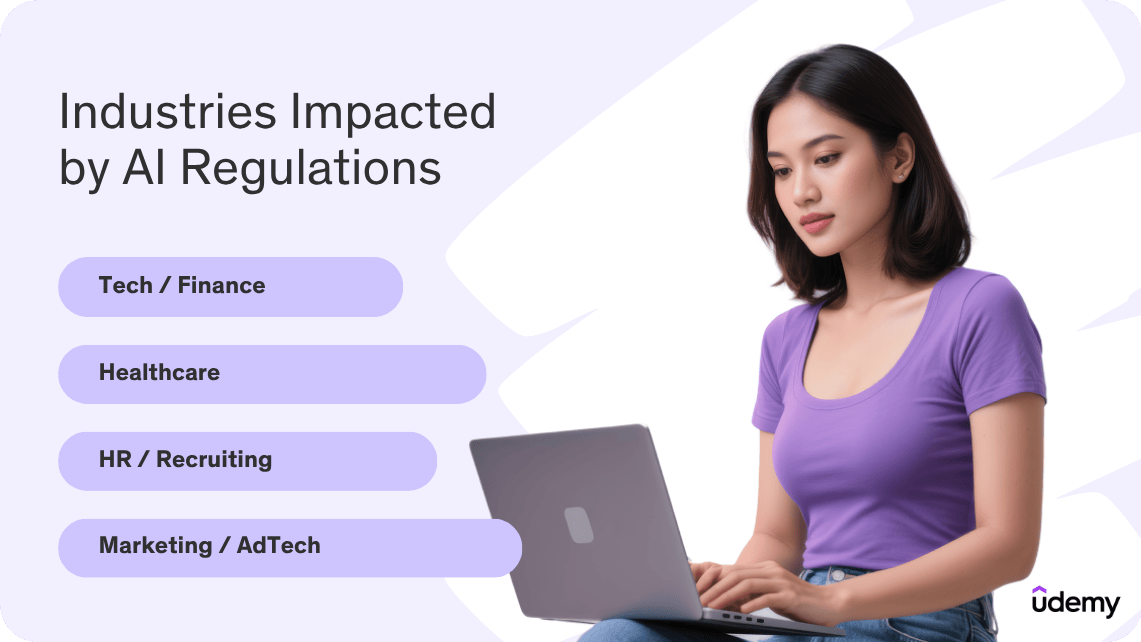
AI impacts every industry, but some are more directly affected than others:
- Tech and finance: Systems that automate financial or security-related decisions — fraud detection, lending, algorithmic trading — are heavily monitored.
- Healthcare: Patient privacy and safety are non-negotiable, so diagnostic or treatment-related AI faces strict approvals and rigorous testing.
- HR and recruiting: Laws are tightening around AI in hiring and promotions. Employers have to prove fairness, not just assume it.
- Marketing and AdTech: Data privacy and consent rules are driving changes in how personalization and targeting are implemented.
For people in these industries, that means jobs are shifting. Compliance and oversight are becoming part of the daily workflow.
Long-Term Opportunities Created by AI Regulation
Yes, regulations can feel like speed bumps. But they can also open up entirely new avenues for career growth.
New roles are emerging
- AI Policy Specialist – helping organizations keep up with global or regional AI regulations.
- AI Compliance Engineer – ensuring companies can successfully build and deploy systems that stay inside the lines.
- Ethical Design Researcher – testing for fairness and inclusivity in AI systems.
- Human-AI Interaction Designer – making sure humans and AI collaborate smoothly.
Soft skills are getting a spotlight
- It’s not all technical. In fact, the rise of AI is bringing an increased demand for soft skills – fulfilling the needs that AI systems can’t. Skills like critical thinking, ethical reasoning, and communication are becoming key career differentiators.
Collaboration is the new normal
AI regulation isn’t something that engineers can always address on their own. It requires teams from legal, policy, data, and product to work side by side. That’s creating more hybrid roles — and new opportunities for people who can connect the dots.
How to Stay Ahead on AI
So, how do you make sure you’re not caught off guard by all this change? Start by pairing technical skills with regulatory awareness.
Stay plugged into policy
Keep an eye on updates from the EU, US, OECD, and UNESCO. Each region has its own set of rules, and understanding the differences, in addition to how each of them affects global regulation as a whole, can give you a leg up.
Build future-forward skills
- Responsible AI practices – frameworks for safety, fairness, and transparency.
- Model auditing and interpretability – being able to test and explain outputs.
- Data privacy rules – from GDPR to evolving US state laws.
- Bias mitigation – spotting and fixing problems before they scale.
Learn by doing
Don’t wait to get started on upskilling when it comes to AI. Udemy offers hands-on courses with practical applications so you can shape the next stage of your career:
The Bottom Line
AI regulation is here. Compliance roles are multiplying, technical jobs are evolving, and soft skills – like communication and ethics – have become more valuable than ever.
Now is the time to invest in yourself. By combining technical know-how with ethical awareness, plus your existing skills, you’ll be ready for whatever comes next.
Top courses in Artificial Intelligence (AI)